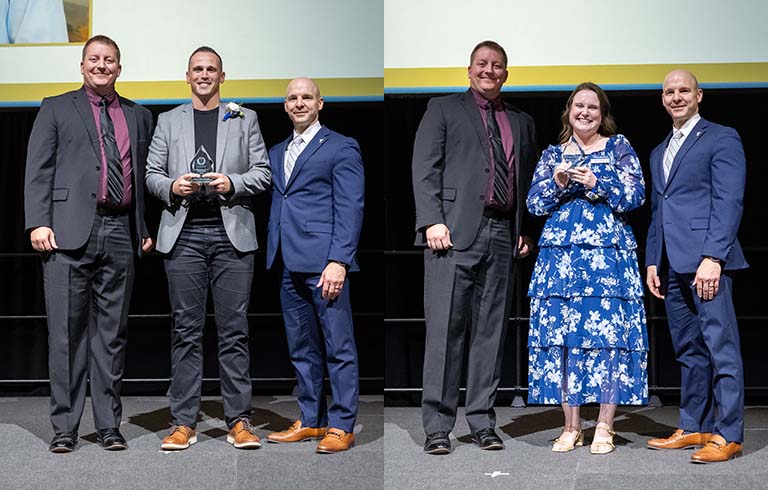
Trine honors alumni at Touchstone
October 6, 2026
Trine University honored two distinguished graduates with alumni awards during its annual Touchstone and Homecoming Celebration Dinner on Friday, Oct. 2.
1/3
June 03, 2026
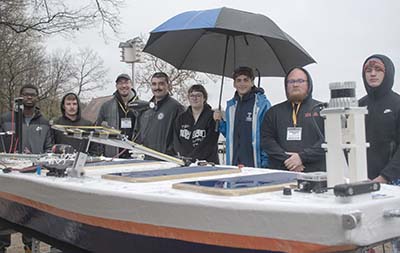
Held in partnership Naval Surface Warfare Center Crane Division (NSWC Crane), the annual event tasks teams of engineering students with guiding a low-profile vessel (LPV) through a series of challenges using artificial intelligence (AI).
Multiple fields
Ten students made up this year’s AIMM team for Trine University, representing several engineering and computing majors: Aylee Rupert, a design engineering technology major from South Bend, Indiana; Taylor Cussen, an electrical engineering major from Granger, Indiana; Nicholas Lugo, a mechanical engineering major from Hammond, Indiana; Dominic Bumpus, an extended reality major from Hillsdale, Michigan; Colten Zableckis, a mechanical engineering major from Cedar Lake, Indiana; Jordan Williams, a mechatronics and robotics engineering major from St. Clair Shores, Michigan; Micheal Alaniz, a design engineering technology major from Lexington, Kentucky; Zakeri Pica, a software engineering major from Fremont, Indiana; Thomas Miller, a mechanical engineering major from Wind Lake, Wisconsin; and Jacob Behm, a mechanical engineering major from Fremont, Indiana.
Williams, who served as team lead, said this year’s entry featured several innovations.
The team developed a crossbow system for delivering payloads rather than a drone after experiencing frequency and connection problems with the drone last year. They also developed a centralized propulsion setup to simulate paddles on a small boat, in order to improve the LPV’s turning radius.
One challenge Williams said the group faced was connecting the Arduino circuit boards used to control their propulsion system to other components.
“To overcome this, we conducted extensive testing and focused on completing competition challenges that did not require long-range communication,” he said.
They also implemented a ballast system with tubing and valves connected to allow lake water to flow into the bags and submerge the boat during competition.
“This gave the team additional points and eliminated the need to add extra weights on top of the LPV solely for competition purposes,” Williams said.
Strong teamwork
Williams said the team worked “extremely well together” and felt very confident going into the competition.
“We believed in the hard work and time we invested, along with the new additions we implemented,” he said.
They learned how quickly time passes throughout the design and fabrication process, he said. They pushed development of several systems back and were eventually unable to make the LPV fully electronic.
“We strongly believe we could have won the competition,” he said. “However, that was not the outcome. The main takeaway from this project is to stay ahead of schedule and avoid procrastination.”
Trine finished fourth in each of the competition categories as well as overall. A team from Indiana University – Bloomington was named overall grand champion.
Williams believes the team has built a strong foundation for next year’s effort.
“We were very intentional about leaving the LPV in a better condition than we found it and giving next year’s team a stronger starting point,” he said. “We left behind detailed code, programs, diagrams, documents and assembly guides for the next team to build upon and improve.”
Trine University honored two distinguished graduates with alumni awards during its annual Touchstone and Homecoming Celebration Dinner on Friday, Oct. 2.
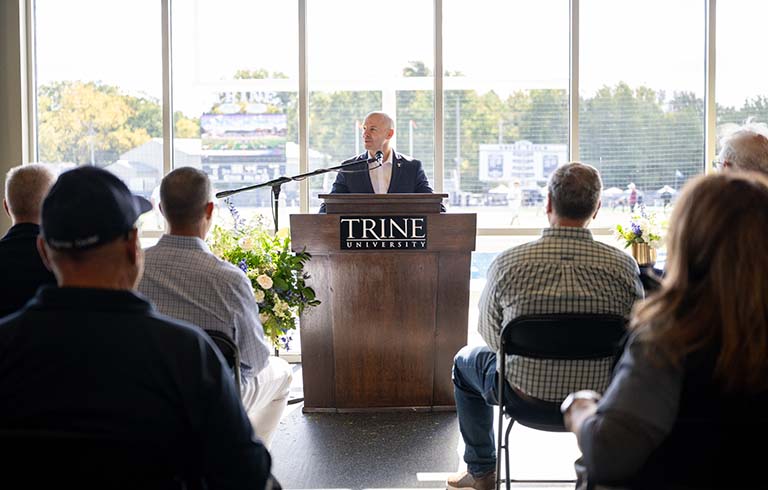
Continuing its support for a premier student experience, Trine University dedicated its new Trine Family Training Center on Saturday, Oct. 3.
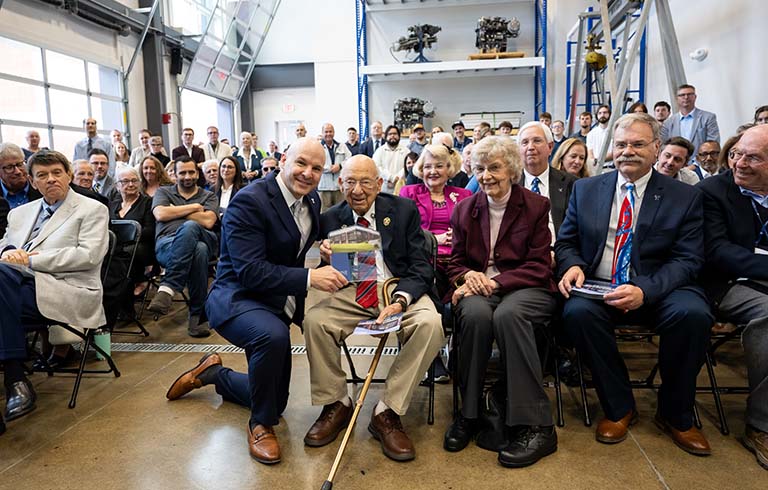
Trine University President Dr. Tony Kline, kneeling, presents a plaque to John and Mary Pellegrino in appreciation of their support for the university’s new John and Mary Pellegrino Student Design Center.