
New Trine University programs offer quicker pathway to careers
October 14, 2026
Students who want to become pharmacists or construction managers will soon have a quicker, more cost-efficient pathway to those careers.
1/3
September 29, 2026
By Taylor Peel
English/Communication ’27
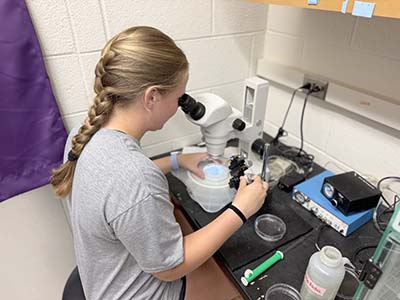
Julia, a biology/pre-physician assistant studies major from Lancaster, New York, first learned about the REU through Trine University’s biology department. The department emailed students about a visit from Katie Drerup, Ph.D., associate professor in University of Wisconsin-Madison’s Department of Biology, who spoke about autophagy (breaking down) in neurons and shared information about an opportunity to participate in a summer REU in her lab.
To apply, Julia completed an online application that included her transcript, résumé, personal statement and the contact information for a reference. A few months later, she completed a Zoom interview with Dr. Drerup and a graduate student who helped run the REU program.
Funded by NSF
The National Science Foundation (NSF) funded the program through a grant awarded to the University of Wisconsin–Madison. The program placed two students from primarily undergraduate institutions in research settings at a large university, giving them the opportunity to work alongside graduate students and principal investigators in large research laboratories.
Through this experience, students gained knowledge and skills while learning how researchers collaborate in complex scientific environments.
Benham worked as an assistant to her primary mentor, a graduate student in the University of Wisconsin–Madison’s Neuroscience Training Program. Her research focused on how zebrafish neurons produce and maintain mitochondria in axon terminals. She cared for the fish, performed microinjections on one-cell-stage embryos, and analyzed confocal microscopy images using ImageJ.
According to Julia, zebrafish are a reliable model organism due to their fast development, transparent larvae and genetic accessibility. This allows the study of neurons in a living system as opposed to in vitro.
In addition to her laboratory work, Julia attended a weekly course on neuronal cell biology, participated in lab meetings and took part in professional development seminars. At the end of the program, she presented her findings to the lab.
“I was ecstatic and very grateful when I was selected for the program,” Julia said. “Research opportunities can be hard to come by as an undergraduate. It was also my first internship related to my career path, so I was excited to get some real-world experience and spend the summer in Madison, Wisconsin.”
Julia credits Trine’s biology department with connecting her to the opportunity and allowing her to learn from experienced mentors.
As she prepares for a career in healthcare, Julia said the skills she developed through research will benefit her future work.
“I will need to use these critical thinking skills daily when treating patients, especially those with more complex diagnoses or treatment plans,” she said.
Julia also drew on the knowledge she gained through her coursework at Trine to understand the complex concepts she encountered during the program. Her research experience gave her a deeper understanding of the scientific method and offered insight into the work researchers conduct behind the scenes to advance patient care.
Students who want to become pharmacists or construction managers will soon have a quicker, more cost-efficient pathway to those careers.
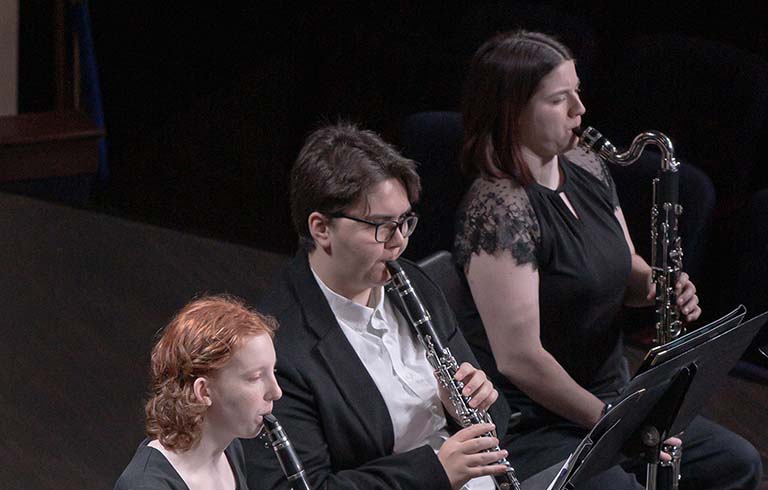
The Trine University music program will open its 2026-2027 concert season with the return of its annual “Halloween Haunt-cert” at 3 p.m. Saturday, Oct. 24.
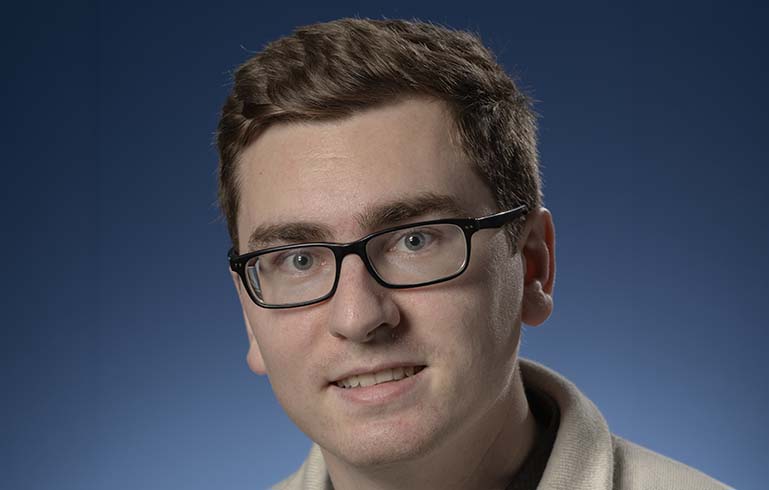
Jeremy Goossens, director of esports and industry innovation at Trine University, was named Director of the Season by ECAC Esports, the comprehensive collegiate esports league where Trine competes, for spring 2026.