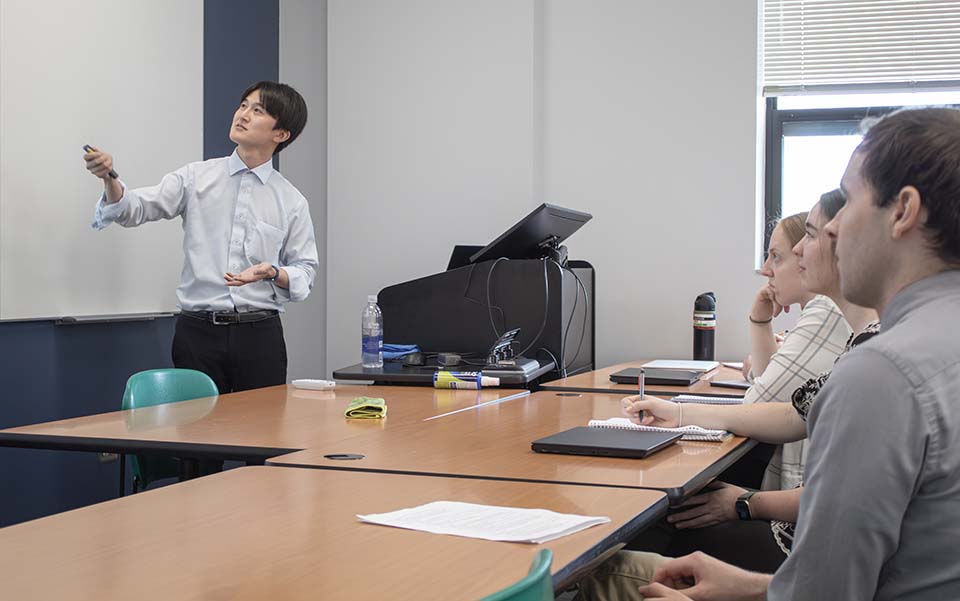
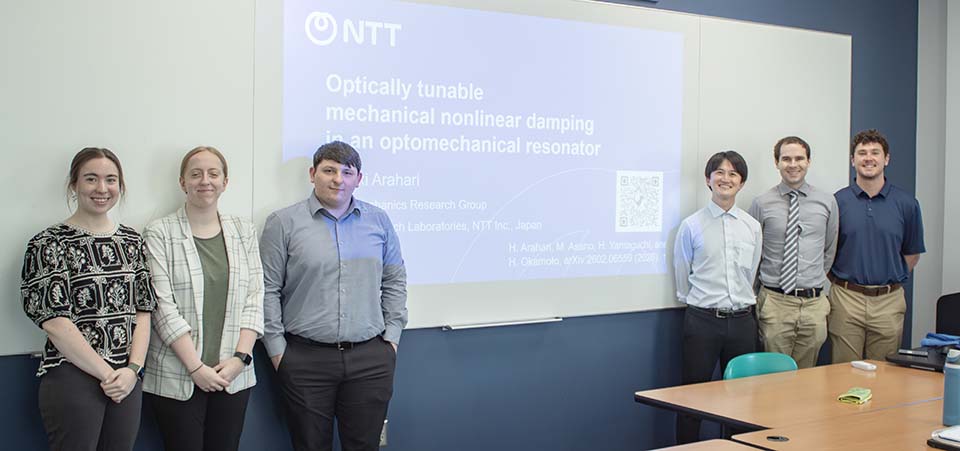
Trine University’s Allen School of Engineering and Computing hosted a seminar by Hideki
Arahari, Ph.D., of Basic Research Laboratories at NTT, Inc. in Japan, on Monday, June
29.
NTT is one of the world’s largest telecommunications companies.
Dr. Arahari’s seminar was followed by presentations of research by Trine University
mechanical engineering majors Maranda Padfield of Kokomo, Indiana, Janna Wilson of
Kokomo, Indiana, Nicholas Ewing of Wabash, Indiana, and Nathan Stefanski of Almont,
Michigan.
The students have been conducting research, guided by James Miller, Ph.D., assistant
professor in the Wade Department of Mechanical and Aerospace Engineering, and funded
by the National Science Foundation, into microelectromechanical systems (MEMS) resonators,
vibrating silicon structures that are smaller than the width of a human hair.
The research seeks to develop techniques to make the resonance frequencies of MEMS
resonators more stable by utilizing controlled mechanical tension, nonlinear operation
and amplifier circuit design to improve their performance.
One technique investigates whether tuning the tension on the resonators — similar
to tightening a guitar string to tune it — will make their frequencies more stable.
This work has applications for improved timekeeping devices, which are ubiquitous
in modern technology such as smartphones, computers and data centers.
Dr. Arahari has conducted related research in the field, studying microscale optomechanical
resonators that introduce coupling between laser light and mechanical vibrations to
control the nonlinear damping — a kind of energy loss in vibrating systems that depends
on how large the vibrations are.
Controlling nonlinear damping will accelerate fundamental studies of nonlinear dynamics
and also has applications for stabilizing the vibration amplitude of next-generation
timekeeping devices.
Dr. Arahari discussed his recent experimental and theoretical research at NTT, which
showed that carefully controlling the coupling between coupled optical and mechanical
modes, and between coupled mechanical modes, can tune the nonlinear damping of the
mechanical vibrations.
The seminars were attended by Trine University faculty from multiple departments.