
Trine collecting food for annual Crush Hunger effort
October 26, 2026
Trine University is collecting food through Nov. 6 for Community Harvest Food Bank’s 12th annual “U Can Crush Hunger” campaign.
1/3
September 01, 2021
 A $15,000 grant from the Indiana Space Grant Consortium (INSGC) will fund an undergraduate
research project at Trine University that seeks to help understand the impact of spacewalks
on astronauts.
A $15,000 grant from the Indiana Space Grant Consortium (INSGC) will fund an undergraduate
research project at Trine University that seeks to help understand the impact of spacewalks
on astronauts.
Trine University biomedical engineering seniors Madison Howard of Pleasant Lake, Michigan, and Ashley Spirrison of Fishers, Indiana, will lead the project, titled “Developing Microfluidic Technology to Model the Vascular Health of Astronauts.” Max Gong, Ph.D., assistant professor in the Bock Department of Biomedical Engineering, will serve as advisor.
The project seeks to help address concerns NASA has regarding the safety of its astronauts while completing missions outside of Earth’s atmosphere, Gong said.
During missions, astronauts execute Extravehicular Activities (EVAs), commonly referred to as spacewalks, to repair and complete quality checks of spacecraft, and for research and exploration purposes. Prior to an EVA, astronauts must be exposed to 100% hyperoxia (a state of excess supply of oxygen in tissues and organs) for approximately five to eight hours, with repeats of the protocol two to three times each week.
This increase in blood oxygenation has been linked to DNA damage to lung tissue, overproduction of nitric oxide, cell damage from lipid peroxidation, and increased pulmonary fibrosis, Gong said.
Hyperoxia also causes blood vessels to narrow and abnormalities in the architecture of organs, limiting blood flow or fluid transfer through organs.
The Trine students will develop microfluidic vasculature-on-a-chip models, engineered models that mimic living tissues, of blood and lymphatic vessels to investigate the relationship between hyperoxia and its negative health effects. Such models have been used to better understand vascular health in diseases, such as atherosclerosis, Gong said, and can be applied to studying and improving the health of astronauts.
The Indiana Space Grant Consortium was created in 1991 under NASA’s National Space Grant College and Fellowship Program. The Space Grant national network includes organizations working to expand opportunities for Americans to learn about and participate in NASA’s aeronautics and space projects by supporting and enhancing science and engineering education, research and public outreach efforts.
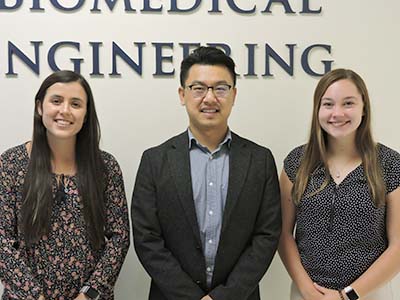
Photo: Trine University biomedical engineering majors Ashley Spirrison, left, and Madison Howard, right, will lead a research project that seeks to help the impact of spacewalks on astronauts. The project received a $15,000 grant from the Indiana Space Grant Consortium (INSGC). Max Gong, Ph.D., center, assistant professor in the Bock Department of Biomedical Engineering, will serve as advisor.
Last Updated: 09/01/2021 Trine University is collecting food through Nov. 6 for Community Harvest Food Bank’s 12th annual “U Can Crush Hunger” campaign.
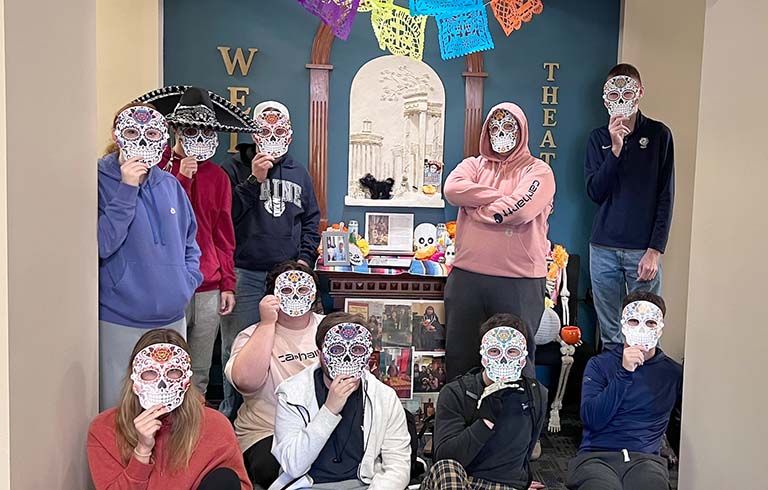
Isabel Soto, instructor, and her Spanish students have created an ofrenda (decorated altar) honoring Ana Boman, who taught Spanish in Trine University’s Department of Humanities and Communication for 16 years before she passed away last year.
Trine University has launched Dual Advantage, a new program that gives undergraduate students multiple pathways to earn both a bachelor’s degree and an advanced degree in less time than completing both degrees separately.