Blast from the past: Trine team engineering new gearbox for popular vintage motorcycle
October 23, 2023
Share
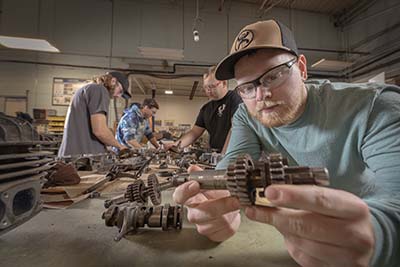
Trine University design engineering technology student Braxton Dial holds a part from
the gearbox of a Honda CR250M Elsinore as senior design teammates, from left, Connor
Miller, Hunter Klutz and Brenten Rodgers work in the background. (Photo by Dean Orewiler)
Introduced 50 years ago, the Honda CR250M Elsinore was the company’s first two-stroke
competition motocross motorcycle, featuring superior performance, lightweight materials,
an affordable price tag and, unfortunately, a notable design flaw in its transmission.
Now, a group of Trine University seniors, in conjunction with project sponsor Replica
Motorcycle Parts, is working to correct that flaw to keep the beloved vintage bikes
in service.
Over this school year, the team of design engineering technology majors Braxton Dial,
Hunter Klutz, Connor Miller and Brenten Rodgers will reverse engineer, update and
remanufacture the gearbox for the Elsinore.
The final product will be metal 3D-printed and sold worldwide by Replica Motorcycle
Parts, a leading provider of vintage motorcycle parts that are no longer available
from the manufacturer.
Motocross for the masses
Named after the famous Elsinore Grand Prix, the CR250M was introduced in 1973. Honda’s
first build-from-scratch entry into motocross, it was the lightest such bike at the
time.
Offering a superior user experience, ergonomics, carburetion, durability and electronics,
the Elsinore not only became popular among enthusiasts and competition racers, it
brought motocross to the masses.
However, the original gearbox had a design flaw that eventually results in the destruction
of the Elsinore’s third and fourth gear set as well as damage to the shifter fork.
“People today still race them,” said Dial. “They have get-togethers and they race
them, and a lot of people have run into the issue we're trying to fix.”
New replacement parts for the Elsinore have not been produced for some time. As a
result, unused or even used parts have become very hard to find and expensive.
Reverse engineering
Replica Motorcycle Parts owner Paul Parkinson connected with Trine University through
a vintage motorcycle event that Roberta Gagnon, assistant professor in the university’s
Department of Design Engineering Technology, follows.
“I chose Trine University due to the staff's understanding of the importance and challenges
of reverse engineering and the role of 3D printing in enabling new solutions,” Parkinson
said. “I’ve been incredibly happy with the knowledge and enthusiasm of Prof. Gagnon
and the student team.”
Replica Motorcycle Parts provided the team with two CR250M engines, which they have
begun disassembling in order to reverse engineer the gearbox and improve upon it using
21st century technology.
“It's pretty exciting because I kind of do this for fun outside of school,” said Dial.
“I like to take something old and try to redesign it and fix it.“
“The biggest challenge is going to be figuring out what their original design intent
was, because things are done completely different now than they were with 1970s technology,”
said Klutz. “We’ve got to figure out how they did it and why they did it.”
Once the team has the gearboxes torn down to their basic components, they will measure
the gears, make CAD drawings and perform finite element analysis to measure the stresses
on the gears from the engine. The process will not only determine the best design
for the new gearbox, but the best material to use for 3D printing its parts.
The team also plans to attend trade shows, including the Performance Racing Industry
show in Indianapolis, to see if there are other techniques they can apply to their
project.
Gagnon said 3D printing of metal gears is a relatively new manufacturing process and
will require post-process heat treatment and machining. The Trine team is researching
existing techniques to determine the best processes for the gearboxes, she said.
“Once everything's good we’ll completely 3D print a whole gearbox design that can
be dropped and ready to go,” Rodgers said.
Miller said that, if Parkinson can allow it, the students would love to field test
an Elsinore with their final product installed.
“We're willing to try it out for him,” he said with a grin.
Trine University has launched Dual Advantage, a new program that gives undergraduate students multiple pathways to earn both a bachelor’s degree and an advanced degree in less time than completing both degrees separately.
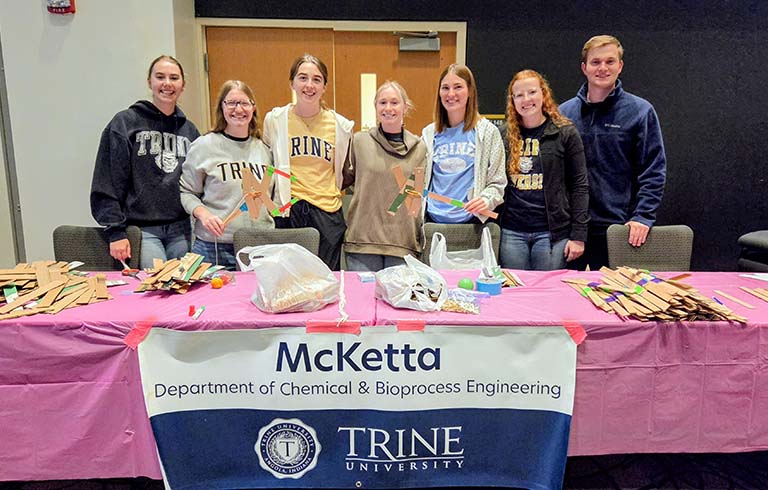
Trine University student organizations and the McKetta Department of Chemical and Bioprocess Engineering recently offered activities for girls interested in science and engineering at the 2026 STEM Expo hosted by the Girl Scouts of Northern Indiana-Michiana (GSNI-M).