By John Clampitt
Communication ’26
Since high school, Trine University student James Kellerstrass has wanted to study
abroad, and Japan was the place he wanted to go.
Kellerstrass, a mechanical engineering major from Berrien Springs, Michigan, and president
of the Study Abroad Club, got the opportunity to do just that this summer, studying
in the country from May 10 to July 15.
“It always fascinated me as a place with a culture so different from our own,” he
said, “along with the technology that comes from Japan being very impressive.”
Kellerstrass had the opportunity to assist with research at Teikyo University, a public
university in Japan known for its engineering curriculum.
Delayed by COVID
When he was accepted into Trine, Kellerstrass’ first action was to call Haseeb Kazi,
Ph.D., the Study Abroad faculty advisor at Trine, and see about opportunities in Japan.
“He then directed me to Mari McHenry, who was in charge of a new program to send a
student to research for two months in Japan,” he said. “I kept trying to take advantage
of this opportunity, but due to COVID it kept getting canceled until this last summer.”
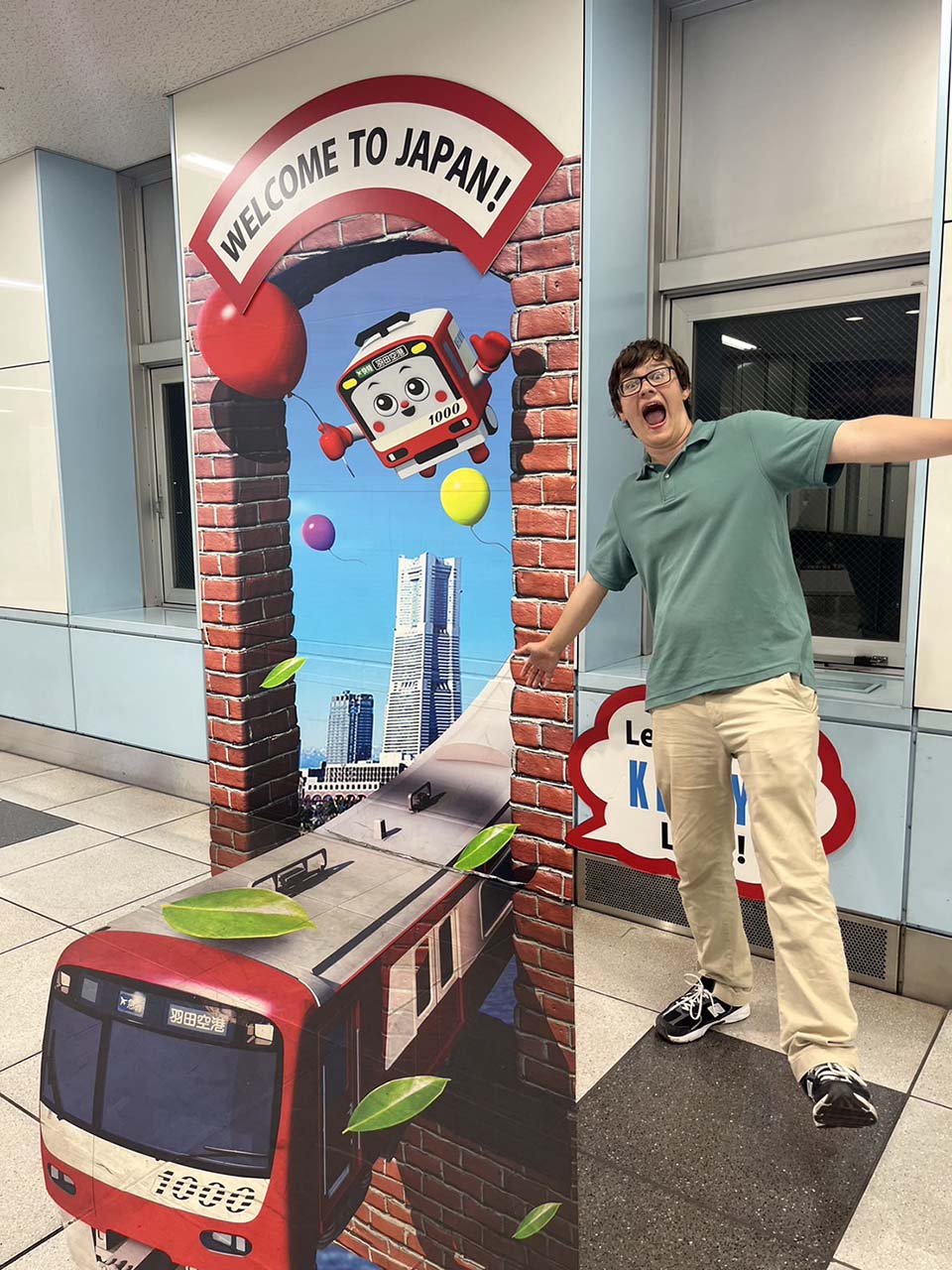
“Japan was my first time flying alone and traveling outside of the USA,” he said.
“It felt surreal [when I arrived], like I wasn’t really there.”
After the initial arrival, he said life didn’t feel significantly different in Japan.
“Surprisingly, being in another country didn't make life feel very different” he said.
“In terms of what happened after I landed: I was picked up by a travel agency that
Teikyo University had hired, who guided me in getting a bullet train to Utsunomiya.
Once there I was brought to the university by staff members of Utsunomiya.”
Abstract algebra
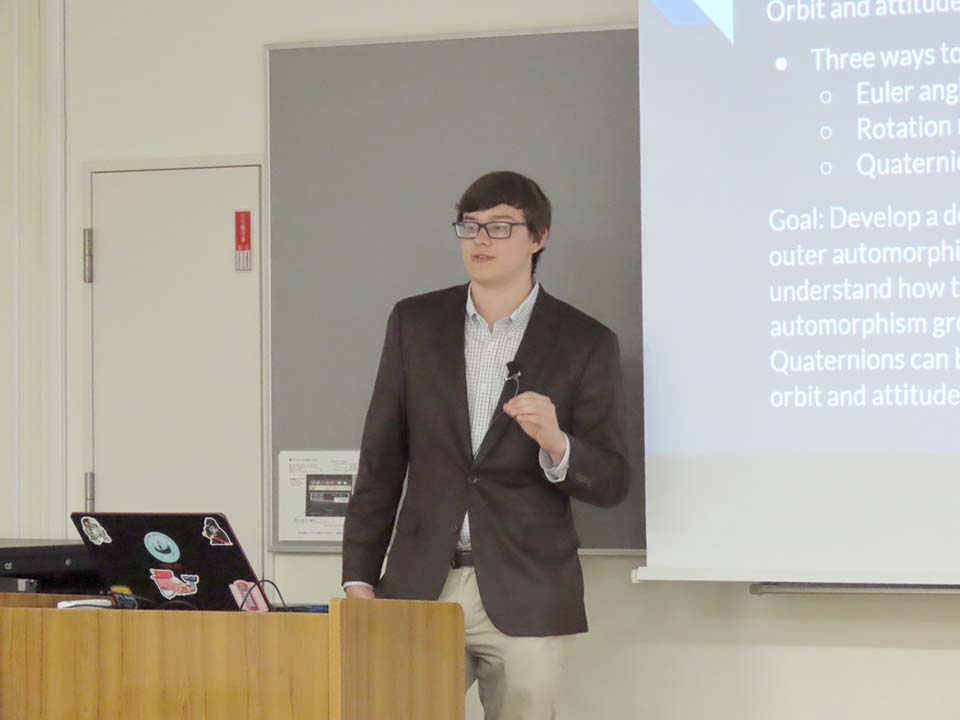
Kellerstrass’ research was focused on automorphisms, a concept in abstract algebra
that has applications to the orbit and altitude of spacecraft.
“Essentially, an automorphism is a function that rearranges how a group looks by changing
where certain aspects of the group go,” he said. “The goal was to be able to take
the outer automorphisms of the quaternion group, which is a group of directions, to
basically be able to predict certain directions of a spacecraft at a given time.”
“I primarily communicated with only a few people, two students and the teacher when
it came to research conversations,” he said. “We mostly talked in English, as my Japanese
was not good enough to have conversations on the same level as the research. There
were often words or concepts that we would get hung up on trying to translate and
at times I would have to re-explain things because of miscommunications.”
“My role was to develop a deep understanding of outer automorphisms, which basically
meant I was researching a small section of the full research project," he said. “This
would help the team with their goal of understanding the quaternion group. Through
guidance from my professor, I was able to teach myself and explore abstract algebra
to come up with a proposition dealing with the nature of outer automorphisms. On a
more social aspect of the trip; the friends I made in Japan would hang out with me
every week, playing games or going on trips.”
Trine gave Kellerstrass great time management skills, and an understanding of the
abstract algebra needed to develop the proposition he made.
“The math I learned here at Trine was invaluable,” he said.
Kellerstrass wants to do research and work in Japan in the future, so this experience
was perfect for him.
“I had the opportunity to really experience what research is like while living in
Japan, learning some of the nuances of Japanese culture and work life,” he said.