Foraging: Trine students learn about wild food options
January 28, 2025
Share
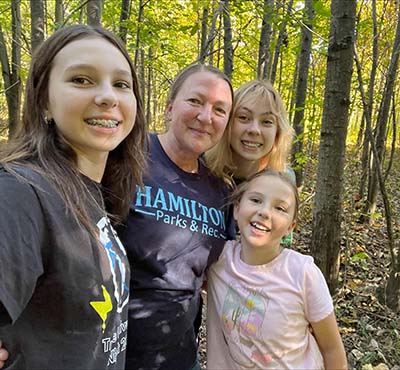
Clockwise from top left: Piper, Brandy, Mia and Annika DePriest on a foraging expedition.
Brandy DePriest lectured to Trine University students on foraging last fall.
Brandy DePriest, Ph.D., chair of Trine University’s Department of Humanities and Communication,
says many people are missing out on a veritable smorgasbord in their front yard.
“The most prevalent weeds around here are dandelion, purslane, lamb's quarter, amaranth
and plantain, to name a few,” she said. “All of these are beneficial herbs that you
can easily incorporate into smoothies, stir fries, stews, salads and much more.”
During the fall semester, she served as a guest lecturer for the HUM 203: The Culture
of Nature courses, speaking on the topic of foraging, which she said is searching
for wild food.
“For wildlife, it just means searching for food, but as humans we can't really call
going to the grocery store foraging,” she said.
Longtime interest
DePriest said she’s not sure exactly when she first became interested in foraging.
“It has evolved over time,” she said. “I helped a friend of mine teach a course called
‘Lunch on your Lawn’ over ten years ago, and this was kind of an extension of that.”
She said that during the COVID-19 pandemic, she and her children went into their woods
nearly every day — rain, snow or shine — to see what was growing and whether it was
edible.
“We have since tracked the woods across seasons and love to go out at certain times
of year to ethically gather food,” she said.
“As a family we love to find/source as much of the food we eat as possible locally.
Teaching my kids that we can grow, forage and hunt — as well as support local farmers
and growers — is the healthiest way to live.”
During the HUM 203 class, DePriest led students to a small meadow of native perennials
located on Zollner Golf Course between Hershey Hall and the MTI Center.
“I taught them how to identify beneficial greens, plants and herbs,” she said. “There
are a lot of leafy greens in our yards that are great-tasting and work well in salads,
stir-fries, and so much more! We also addressed what and how to forage year-round,
including a discussion on how to always be sure that what you are foraging is done
so ethically and safely.”
In addition to leafy greens, DePriest said northeast Indiana offers morels and other
delicious mushrooms, ramps and different berries for foragers.
“I think that people are hesitant to use them largely because they don't realize what
they are,” she said. “We want our lawns to look nice and be free of weeds, but as
a culture we've largely lost our connection to the foods produced by the land that
we once survived on.”
Trine University has launched Dual Advantage, a new program that gives undergraduate students multiple pathways to earn both a bachelor’s degree and an advanced degree in less time than completing both degrees separately.
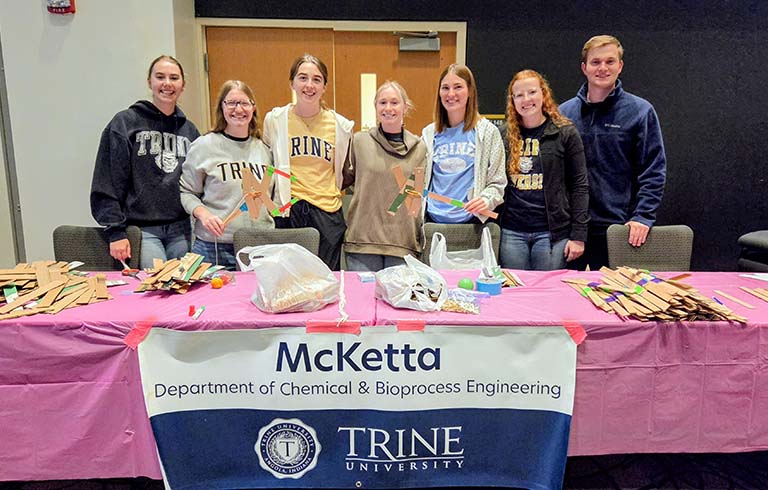
Trine University student organizations and the McKetta Department of Chemical and Bioprocess Engineering recently offered activities for girls interested in science and engineering at the 2026 STEM Expo hosted by the Girl Scouts of Northern Indiana-Michiana (GSNI-M).