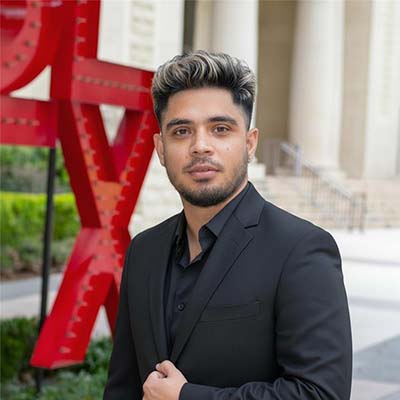
 Alence Poudel had a strong civil engineering background but saw the need for wider
expertise in his work.
Alence Poudel had a strong civil engineering background but saw the need for wider
expertise in his work.
Seeing missed opportunities to use data to solve increasingly complex infrastructure
challenges, Alence enrolled in Trine University’s Master of Science in Business Analytics
(MSBA) program.
He was named the Outstanding Student for the program for the Class of 2026.
Overcoming limitations
Alence already held a bachelor’s and master’s in civil engineering while working for
the Engineering Department for the city of Sugar Land, Texas.
He noticed limitations to traditional municipal engineering approaches.
“Large amounts of data were available but underutilized,” he said. “I wanted to build
the ability to integrate data-driven thinking into real-world engineering decisions.
I wanted to move beyond conventional approaches and develop the skills needed to analyze
uncertainty, forecast outcomes and support more informed infrastructure strategies.”
He chose Trine’s program because of its flexibility and its strong focus on applied
analytics.
“The program allowed me to continue working while directly applying what I was learning
in a live municipal environment,” he said. “That combination of academic foundation
and real-world implementation was exactly what I was looking for.”
He said the MSBA allowed him to approach infrastructure problems not just from a design
perspective, but from a systems and decision-making perspective.
“Many of the discussions and projects encouraged independent thinking, reflection
and practical application,” he said. “This made it possible for me to continuously
test ideas, refine approaches and align academic work with actual problems I was working
on in my professional role.”
“I consistently applied concepts from classes such as data mining, statistical modeling
and operations analytics directly to projects within the city of Sugar Land, leading
to the development of multiple frameworks for infrastructure planning and risk assessment,
including work on dual horizon planning for water main systems.”
The city implemented the frameworks beginning in 2025. Alence also developed them
into research publications.
The Water Environment Association of Texas (WEAT) recognized one of his projects with
the 2026 Innovative Technology of the Year Award.
Scaling his work
He plans to continue expanding and refining his frameworks to apply them to broader
infrastructure planning and operational challenges. Eventually, he wants to scale
them so they can be used more widely across municipal systems.
“Long-term, I aim to take on leadership roles focused on smart infrastructure planning
and delivery in larger cities, where I can help integrate data-driven decision-making
into core engineering processes,” he said. “I also intend to continue contributing
to applied research and developing practical, open, adaptable solutions that others
can build upon.”
He said Trine’s MSBA program is particularly valuable for those willing to take initiative,
connect coursework to their professional experience and go beyond standard requirements.
“Students who approach it with that mindset can gain much more than technical skills.
They can develop the ability to solve complex, real-world problems and create meaningful
impact in their respective fields,” he said.