 “When I first arrived at Trine, I expected to earn an advanced degree that would strengthen
my professional qualifications. What I did not expect was that it would completely
reshape the direction of my career.”
“When I first arrived at Trine, I expected to earn an advanced degree that would strengthen
my professional qualifications. What I did not expect was that it would completely
reshape the direction of my career.”
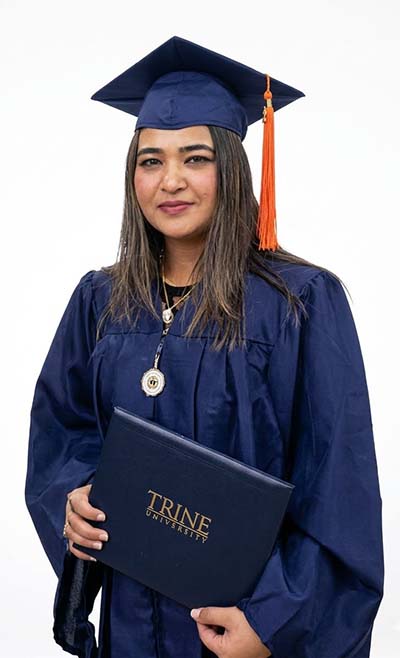
Kamana Parvej Mishu had worked for more than 11 years as an aviation safety inspector
(airworthiness) with the Civil Aviation Authority of Bangladesh. She realized her
field was changing rapidly and wanted to drive transformation rather than catch up
to it.
When she started searching for graduate programs, Trine University's Master of Science
in Engineering Management/Industrial stood out with its combination of engineering
with management, manufacturing, quality improvement and systems thinking.
Big step
Kamana moved to the United States in 2023 to begin the program. She said it was one
of the biggest decisions of her life.
“It wasn't simply another degree for me; it was an opportunity to reinvent my career
while building on the technical experience I had gained in aviation,” she commented.
Her courses at Trine provided her with a new perspective on engineering. Where before
she had learned to maintain safe, reliable aviation systems, her classes helped her
apply the same principles to manufacturing, supply chains, industrial operations and
emerging technologies.
“(They) strengthened my ability to think across entire systems instead of focusing
on individual processes,” she said. “I developed a deeper understanding of process
improvement, operational efficiency, quality management and data-driven decision-making.”
She appreciated the opportunity to complete hands-on experiences that solved real
industrial problems.
One project, she said, focused on artificial-intelligence-driven supply chain optimization.
She analyzed manufacturing and supply chain data using Excel and Minitab to explore
predictive approaches for inventory planning and operational decision-making.
“It was fascinating to see how engineering, statistics and data analytics could work
together to improve business performance,” she commented.
She also enjoyed learning with classmates from diverse professional and cultural backgrounds
and especially benefitted from the encouragement and mentorship she received from
Trine's faculty.
“They challenged me to think critically, communicate ideas clearly and pursue research
beyond the classroom,” she said. “Looking back, those experiences played a significant
role in shaping the direction of my career.”
Shift to research
As a result of her Trine education, Kamana decided to shift her career to work in
engineering research. Since graduating with a 3.95 grade point average in December
2025, she already has published research in peer-reviewed international journals and
presented work at conferences associated with the Institute of Electrical and Electronics
Engineers.
“My research explores how AI, machine learning, predictive analytics and optimization
techniques can help industries improve manufacturing performance, strengthen supply
chain resilience and support smarter industrial systems,” she said. “Every project
builds on the system-thinking mindset that I developed at Trine.”
She plans to pursue a Ph.D. in industrial and systems engineering, focusing on artificial
intelligence, smart manufacturing, resilient supply chains, predictive maintenance
and intelligent transportation systems. She hopes to collaborate with industry to
develop practical engineering solutions that create measurable impact.
“My goal is not only to publish research, but to translate innovative ideas into technologies
and decision-support tools that help industries become safer, more efficient and more
resilient,” she said.
As she continues her journey into education research, she credits her Trine education
as being the catalyst for the change.
“Trine University gave me the knowledge, confidence and perspective to step beyond
my previous career and pursue a future dedicated to innovation, research and lifelong
learning,” she said. “I will always be grateful for the education and opportunities
that Trine provided.”