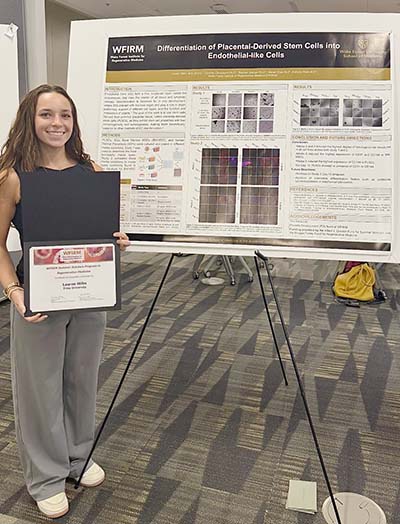
 Lauren Hillin, a biology student on the pre-med track at Trine University, gained
important research skills in her summer internship at the Wake Forest Institute for
Regenerative Medicine in Winston-Salem, North Carolina.
Lauren Hillin, a biology student on the pre-med track at Trine University, gained
important research skills in her summer internship at the Wake Forest Institute for
Regenerative Medicine in Winston-Salem, North Carolina.
The Charlotte, North Carolina, student heard about the internship from the National
Science Foundation’s REU website and quickly entered a pool of around 600 applicants.
Her application process included answering questions about her previous experience
and writing two 650-word essays.
Of the 600 applicants, Lauren and 25 others were selected.
“I was excited! I had an opportunity to explore a new field I had never seen and
make new connections, while also being close to home,” Lauren said when asked about
the internship selection.
Lauren spent her 10-week research internship under a co-mentorship with Anthony Atala,
M.D., and Weixin Zhao, M.D. She studied how to make blood-vessel-like cells from stem
cells so that larger 3D-printed organs can develop their own blood-vessel networks
and potentially function properly.
Cell differentiation
While in the internship, most of Lauren’s tasks were decided by her principal investigator
(PI) before she arrived at the institute. Once she began, she received a stack of
papers to read and provide her opinion on different aspects of the project. This allowed
her to customize the project to learn the things she was interested in.
Because the research is limited on using placental stem cells for endothelial cell
differentiation, the researchers employed methods that used bone marrow mesenchymal
stem cells (BM-MSCs). They began studying which of the BM-MSC methods had a similar
differentiation effect on placental stem cells. They then repeated effective methods
to add new conditions.
“I ran the entirety of the lab work by myself after the second week of the internship,
including media changes, imaging, staining and replating our cells into Matrigel for
a tubulogenesis assay (which we use to see if the cells begin to form branches like
a blood vessel would),” Lauren said.
She also attended weekly lab-wide meetings and presented her project progress. She
completed the internship by giving an oral presentation and a poster presentation
in front of the institute and guests.
“I loved the entire experience. The lab itself and the projects happening were incredible
to learn about, and the way that my project fit into the bigger overarching goals
of the institute was clear,” Lauren said.
She had opportunities to sit in at meetings, ask questions and learn as much as she
could about the research others were doing around her.
“I also got to live in the Wake Forest housing with my entire cohort, so anytime we
weren’t in lab, we were hanging out and doing things together — from going to concerts
and hiking to taking a weekend to go to the beach,” Lauren said.
Applying her Trine education
During this experience, Lauren had the chance to apply several elements of her education
at Trine. She was able to demonstrate her learning from her quantitative chemical
analysis lab, where she learned about precision to reduce variations in results.
Classes like cell biology and biochemistry taught her what she needed to know about
cells, cell growth and cell regeneration, which she could apply to her project and
use to understand scientific papers.
In her professional practice class, she learned how to create scientific posters,
give oral presentations and present scientific information in an accessible and coherent
way. This was used in the end-of-program symposium at Wake Forest.
“As a pre-med, research is an important aspect that helps you to be a well-rounded
physician. It gives you an appreciation for the work necessary behind the scenes to
offer treatment options, medications and clinical trials. Medicine and research go
hand in hand, and it was an opportunity to explore different fields of medicine and
gain undergraduate research experience to apply in medical school and beyond if I
work in a clinical-based research setting,” Lauren said.