Trine alum, current student work together on summer research project
August 21, 2026
Share
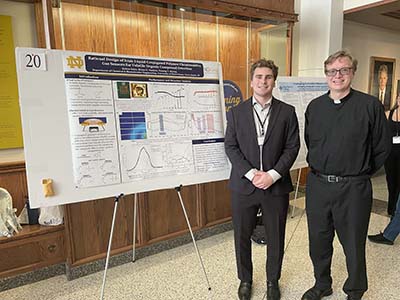
Keiton Klein, left, and Fr. Bryan Paulsen, S.J., Ph.D., stand with Keiton's research
poster at the Notre Dame Summer Undergraduate Research Symposium.
Having graduated from Trine University, Fr. Bryan Paulsen, S.J., Ph.D., hoped to have
a current Trine student work as part of his Research Experience for Undergraduates
(REU) team this summer at the University of Notre Dame.
“When you know a place and you know the professors and you know you're going to get
a good student, that's the best way to go,” he commented.
That hope was fulfilled when Keiton Klein, a Trine University chemical engineering
major from Bellingham, Washington, agreed to join Bryan’s team to work on research
into organic mixed conductors — plastics that conduct both electricity and salt.
Such plastics have many applications, Bryan said, including potentially serving as
better links between electronic equipment and the human brain.
Journey of faith, research
After graduating from what was then Tri-State in 2006, Bryan earned his Ph.D. from
the University of Minnesota. There his research focused on plastic-based solar cell
and transistor devices.
While at Minnesota, he became Roman Catholic and joined the Jesuit order after completing
his doctorate. One of the order’s pillars is education, and Bryan’s superiors directed
him to continue in higher education.
“We had a lot of conversations about how to best do that, and one of the key things
was I had to get back in the lab and get back to producing publications, because that's
what people look at when they hire professors,” he recalled. “And so, after my philosophy
studies, they let me go to Northwestern to do a postdoc in biomedical engineering.”
Afterward, he completed his M.Div. in preparation for ordination at Santa Clara University
while simultaneously continuing his research at Stanford.
Being both a priest and an engineering Ph.D. caught the attention of the University
of Notre Dame, which hired him as an assistant professor of chemical and biomolecular
engineering in 2024.
He uses a textbook authored by his former Tri-State professor, Allen Hersel, Ph.D.,
for his Heat and Mass Transport class at Notre Dame. He invited Dr. Hersel, who still
serves as professor of chemical engineering at Trine, to bring students to Notre Dame
for a possible machine learning collaboration.
“Dr. Hersel has his students do some really cool machine learning projects, and that's
actually an area we're looking into,” Bryan said.
Trine connection
Keiton was one of the students who traveled to Notre Dame.
“I found out on the drive to Notre Dame from Dr. Hersel that Dr. Paulsen is a Trine
alum,” Keiton said. “It was cool how he wanted to involve his alma mater in his research
and create opportunities for Trine students to gain hands-on research experience.”
During his visit, Bryan invited Keiton to be part of the REU this summer, and Keiton
accepted.
Keiton’s research project has focused on investigating polymers to create low-cost,
scalable, energy-efficient sensors that can detect harmful chemicals in the air. Specifically,
he blended salts with conducting polymers to make them sensitive to refrigerant leaks.
Modern refrigerants, Bryan said, are inert gases and therefore difficult to detect,
but harmful to the atmosphere. Modern refrigerants are also more flammable than those
used in the past, raising safety concerns.
“Most of the refrigerant in your AC in your car or your house is going to leak into
the atmosphere eventually,” he said. “You won't notice a serious performance issue
until you've already lost about a quarter of that refrigerant.”
Notre Dame is working with other universities as well as industrial partners on the
research.
After fabricating and characterizing polymer films, Keiton conducted gas-sensing experiments,
analyzed the resulting data and helped evaluate how changes in material structure
affected sensor performance.
Bryan said Keiton developed one sensor that successfully tested for one particular
refrigerant at a concentration of one part per million.
“That's pretty rare for a 10-week REU,” Bryan said.
“I could basically throw anything at him and he'd give it a go,” Bryan commented.
“I was like, here are some complicated photophysics of these polymers. He dove right
in, and was very, very courageous, like, ‘I'll try to vibe code something up, and
we'll make it work.’ ”
“He was the ideal candidate. I could see his skills are applicable only in the lab,
but in industry and management. Keiton's going to do very, very well.”
Similarly, Keiton appreciated Bryan’s passion for his research as well as his continued
pride in Trine University.
“He’s there to help every day with troubleshooting or dive into other things in the
lab that aren’t going as expected,” Keiton said. “I learned a lot under his mentorship
and the opportunity he gave me in his lab this summer.”
“Whenever a guest visited our group and we did icebreakers, Dr. Paulsen always made
sure I told them what university I attend and he would proudly jump in to mention
that he went there too, but it was called Tri-State at the time. It was cool to see
how happy he was to tell people he attended Trine during those introductions.”
“Over the past 23 years at Tri-State and Trine, the good Lord has truly blessed me
with the opportunity to teach and get to know so many outstanding students and individuals,”
said Dr. Hersel. “I am especially grateful to Father Paulsen for the incredible experience
he provided Keiton. His guidance, support and influence made a lasting impact, and
I couldn't be more thankful.”
Additional opportunities
Bryan encourages any other Trine students who have an interest to apply to the REU
programs at Notre Dame.
“We have quite a few different programs they can do,” he said. “And they should be
applying here to grad school, especially if they want to stay in the region and they
want to have a very good graduate education on the science and engineering side.”
He would love for one of those graduate students to be Keiton.
“I pressured him to definitely apply to Notre Dame for his Ph.D., but I'm also excited
because he's also looking at some premier places like Stanford and UW Seattle,” Bryan
said. “I'll be very proud wherever he lands.”
Keiton said he plans to transition into industry for a year before potentially starting
graduate school, and the REU “has been excellent preparation for either path.”
“The fast-paced environment and the teamwork required in the lab have equipped me
with adaptable skills that will easily translate to both industry and advancing in
my academic career,” he said.
Trine University’s Brooks College of Health Professions will host a special event highlighting careers and education in occupational therapy from 11 a.m. to 2 p.m. Tuesday, Oct. 20.
Trine University student Julia Benham participated in a Research Experience for Undergraduates (REU) this summer, gaining hands-on research experience at the University of Wisconsin–Madison.
Trine University student Claire Schmaltz spent her summer applying her environmental science and biology studies as an ecological crew member with Battelle Energy Alliance at Idaho National Laboratory (INL) in Idaho Falls, Idaho.