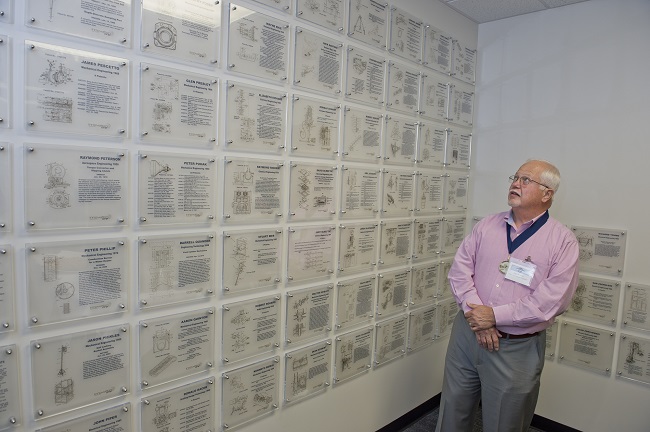
Dean Schmidt, a 1966 Trine University mechanical engineering alumnus, looks at some
of the plaques displayed in the university's Hall of Innovation.
Featuring innovations including everything from a slot car track loop to the ground
fault circuit interrupter found in modern homes, Trine University’s Hall of Innovation
opened to the public during the university’s homecoming celebration.
Located on the second floor of the Jim and Joan Bock Center for Innovation and Biomedical
Engineering, the Hall of Innovation showcases Trine University alumni who have reported
to Innovation One, the university’s incubator for business, invention and design,
that they hold a patent. At the time of its unveiling, the Hall featured plaques for
177 patent holders, who were responsible for about 920 patents.
“We had known for a while that there were a number of influential alumni who had patents
and had invented things throughout their career,” said Jason Blume, executive director
of Innovation One. “We opened up a search and started talking to people, and that’s
really how it got started.”
Each plaque in the Hall highlights an individual patent holder. Single patents are
featured on the plaques of those alumni who have one, while plaques for multiple-patent
holders include the number of patents held with a brief description of some of the
patents.
Patents featured include an inflatable fan finger for sporting events, the internal
workings and cutting surfaces for a blender, a loop for a slot car track, a rotary
tackle box for fly fishing, the technology that forms the basis for cruise control
in automobiles, various designs for knee and hip replacements, a bracket that can
join vertebrae for patients who have vertebrae deteriorating in their back, and the
ground fault circuit interrupter.
Most of the alumni featured are engineering majors, with a handful of business majors,
Blume said.
The oldest alumnus featured is Robert Pocock, a chemical engineering graduate from
the Class of 1931, while the newest is Bryan Bowman, a design engineering technology
major from the Class of 2011. David Ours, a 1973 mechanical engineering graduate,
has the most patents, with more than 30 to his credit.
The most prolific Trine University class is the Class of 1966, which celebrated its
50th reunion during the homecoming festivities. That class includes several members with
20 or more patents.
The Hall will be “continually growing and dynamic” as Innovation One learns of more
patents and as newer Trine alumni patent their own innovations, Blume said. Trine
alumni who would like to have their patent included can email innovation1@trine.edu or call Innovation One at (260) 665-4983.
“We’ll do the research, we’ll validate that they’re on the patent and we’ll validate
that they’re an alum and their graduation year and major,” Blume said. “Then we’ll
get them added to the wall.”
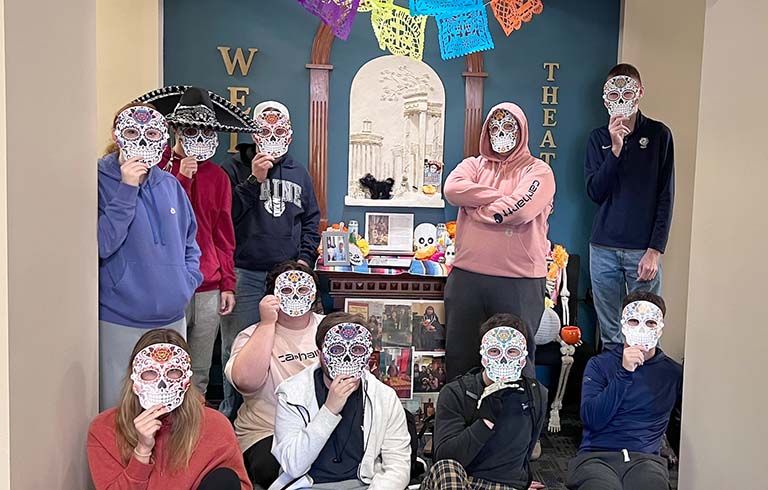
Isabel Soto, instructor, and her Spanish students have created an ofrenda (decorated altar) honoring Ana Boman, who taught Spanish in Trine University’s Department of Humanities and Communication for 16 years before she passed away last year.
Trine University has launched Dual Advantage, a new program that gives undergraduate students multiple pathways to earn both a bachelor’s degree and an advanced degree in less time than completing both degrees separately.