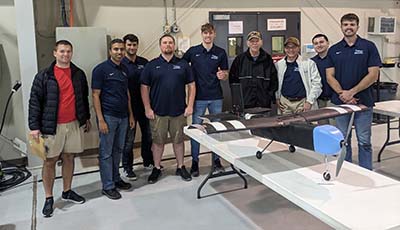
The Trine University Design Build Fly team with American Institute of Aeronautics
and Astronautics tech inspectors at the national competition. From left, a tech inspector;
Gurudutt Chandrashekar, Ph.D., faculty advisor; Ryan Harris; Levi Peterson; Hayden
Rader; another tech inspector; David Love; Bailey Zurface; and Gavin Hettler. Love,
a civil engineering major, served as pilot for Trine’s aircraft.
WICHITA, Kan. — For the first time, Trine University’s entry in the American Institute
of Aeronautics and Astronautics (AIAA) Design Build Fly competition featured custom-manufactured
carbon fiber components, allowing the aircraft to earn one of Trine’s best-ever finishes.
Trine placed 55th out of 107 teams that competed in the event, held April 18-20 in Wichita, Kansas.
The team was comprised of mechanical engineering majors Zach Griffith of Springport,
Michigan, Ryan Harris of Warsaw, Indiana, Gavin Hettler of Coatesville, Indiana, Levi
Peterson of Portland, Indiana, Hayden Rader of Arcadia, Ohio, and Bailey Zurface of
Spencer, Indiana.
Developing processes
The team decided to use carbon fiber because it allowed them to reduce the weight
of their aircraft while increasing stiffness. However, that meant they had to develop
processes for working with the carbon fiber.
“Our plane was required to have a takeoff distance under 20 feet, so any weight we
added during construction would come back to bite us in our scores, but it needed
to be strong enough to support itself as well,” Peterson said.
“We taught ourselves everything we know about the best ways to manufacture carbon
fiber to build this plane and have helped foster the birth of a composites research
lab on campus.”
“Preparation of molds and lay-up methods can be quite challenging when fabricating
aircraft parts with complex geometries,” noted Gurudutt Chandrashekar, Ph.D., assistant
professor and faculty advisor. “With extensive literature research, the team devised
mold-making methods that aided in building multiple planes within a short period of
time.”
“We also were one of the first teams to successfully use 3D-printed components in
highly loaded structures,” said Rader. “Our wing mounting was entirely 3D printed
as well as our pins that allowed the wings to fold. Our tail mounts, fuse mount and
front landing gear servo mount were all also 3D printed.”
The team was able to leverage work and classroom experience and training throughout
the manufacturing and assembly process. However, none of them had experience with
remote control systems.
“In total, it took me over a week just to learn how to program the controller for
the airplane, and I know that I haven’t even scratched the surface of how complex
most of these systems are,” said Peterson.
Top competition, windy conditions
Team members said flying to Wichita for the competition gave them the confidence that
they deserved to compete with some of the top aerospace engineering programs in the
world.
“It made me feel like all the hard work and heavy lifting throughout the year had
paid off,” said Hettler.
Conditions during the competition were windy, resulting in many aircraft crashing.
However, the Trine team was able to successfully complete their first mission.
“We didn’t make the takeoff requirement on the first go around, so the pilot had to
swing the plane back around and make a quick landing,” said Hettler. “When doing this
he landed very hard and bent the front landing gear. I ran back out there and bent
it back into place and he took off again. This time the takeoff was successful, all
laps were flown and the landing was successful.”
“The absolute whirlwind of this whole scenario was awesome, and it felt amazing when
he landed.”
Unfortunately, the continued winds and a motor failure resulted in a crash on the
second mission. While Trine finished 12 spots higher than the judges had ranked the
team at the start of competition, the team was disappointed they didn’t perform better.
“We only completed two of the four missions,” said Rader. “Had we completed the other
two, we would have placed in the top 25-30.”
Despite not placing as high as they would have liked, the team said the experience
was unforgettable.
“I feel as if it strengthened my relationship even more with the entire group,” said
Rader.
“I don’t know if I am ever going to touch model RC again, at least not immediately
after this project, but I may have to revisit it in a few years when I can stomach
crashing planes again,” said Peterson.
Trine University has launched Dual Advantage, a new program that gives undergraduate students multiple pathways to earn both a bachelor’s degree and an advanced degree in less time than completing both degrees separately.
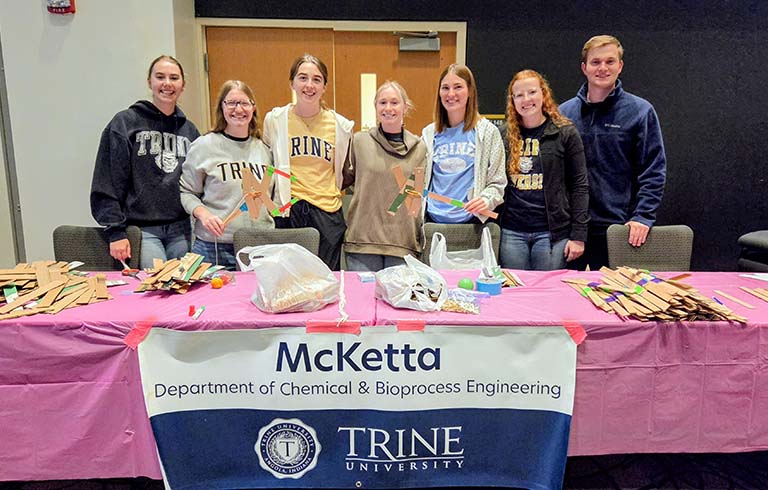
Trine University student organizations and the McKetta Department of Chemical and Bioprocess Engineering recently offered activities for girls interested in science and engineering at the 2026 STEM Expo hosted by the Girl Scouts of Northern Indiana-Michiana (GSNI-M).