On target: Trine team designing archery solution for disabled veteran
March 19, 2026
Share
Video by Leah Reiniche
Injuries sustained during the Gulf War robbed Chester Evitt of the ability to enjoy
archery.
A Trine University senior design group is working to give that ability back to him.
“I used to be good enough with the bow that I could tell you, ‘Lay a $1 bill on the
table and I’ll bet you that dollar bill I could put two arrows inside of each other,’
and I could do it faithfully,” Evitt recalled. “Now, just holding my bow yesterday
about broke this old man down like an old shotgun.”
“My wife, when this all went down, she says, ‘You think you’ll be able to do it again?’
I said, ‘That’s my goal.’ ”
Giving back to those who served
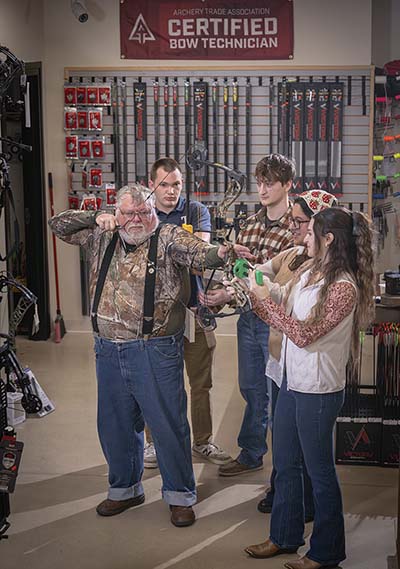
From left, Chester Evitt holds a bow with the help of a device developed by Trine
University engineering students Jake Welker, Cooper Clark, Andrea Mendoza and Ava
Dobbins. (Photo by Dean Orewiler / Trine University)
The project is one of several that Trine senior design groups are working on this
year in partnership with Project S.E.R.V.E., a nonprofit that pairs disabled veterans
and first responders with universities to develop solutions to enhance quality of
life for the veterans.
The chance to make such a positive impact for Evitt is what drew the Trine students
to the project, including Ava Dobbins, a biomedical engineering major from Barberton,
Ohio, who is serving as team lead.
“I was interested not only because I enjoy the outdoors, but also because I wanted
to be part of something bigger than myself, helping a veteran who was willing to give
everything regain the opportunity to return to bow hunting,” she said.
“I have many veterans in my family,” commented team member Jake Welker, a design engineering
technology major from Clayton, North Carolina. “I want to not only give back to veterans,
but those who have lost their hobby and want a chance to do it again.”
Lifelong love of archery
Evitt, who grew up in southern Indiana and now lives in Montana, fell in love with
archery at age 8, when his foster father bought him his first bow.
“I took my first deer in Harrison County, Indiana, and I’ve been addicted ever since,”
he said. “We raised three sons and a daughter and they all love archery. It’s just
been part of my life.”
Gulf War wounds to his arm and chest impacted his ability to use a bow, but he was
still able to hunt until another injury three years ago left him unable to draw.
“I felt robbed and really bummed out,” he said. “When I was healing, all my buddies
were coming out to where we live, and we live in the finest place to elk hunt in the
United States. I had to sit in my jeep and watch them go hunting and watch elk walk
by.”
When first approached about working with the Trine students, Evitt was skeptical,
not because he doubted their abilities but because he doubted his own.
“They proved me wrong,” he said.
Lines of communication
Evitt said the process of designing a device was “chaotic” at first because he and
the students were trying to learn about each other and how they communicated.
“After a while, we figured out what to say and how to say it to where they understood
what I need and I understood where they were trying to go,” he said.
“Staying in communication with the customer was vital for this project. We asked questions
about his needs and interpreted his needs into a product,” said team member Cooper
Clark, a biomedical engineering major from Holiday City, Ohio.
Dobbins said the group generated some 40 initial concepts.
“We went through several iterations of the first design to fully understand what direction
we wanted to go,” commented team member Andrea Mendoza, a biomedical engineering major
from LaGrange, Indiana.
Mendoza said the team listed the most valuable features of each design and ran them
through a selection matrix, weighing each feature based on criteria provided by Evitt
as well as technical specifications.
“That allowed for us to narrow down our options and make a design that would incorporate
the needed features,” she said.
Dobbins said the team created its first iteration using low-cost materials such as
PVC piping and 3D-printed components. The second phase of prototypes used finalized
materials, including carbon fiber and canvas fabric.
Testing and refining
Evitt traveled to Angola, Indiana, recently to meet the team and test their design
at Thunder Lakes, a local archery and gun shop that provided guidance to the students.
Though they are continuing to improve the design, the team and Evitt are confident
the final product will soon have him shooting a bow again. They hope it also will
provide a solution for others with similar injuries.
“We have come so far and accomplished so much, with the help of our customer I am
very confident we will create an effective, accessible device to help him enjoy the
hobby he once loved,” Welker said.
The team is grateful to Thunder Lakes and Angola Canvas for their assistance and expertise
during the project.
“We truly could not have done this without the support of these local businesses,”
said Dobbins.
As for Evitt, he is looking forward to taking part in archery competitions for disabled
veterans and has nothing but praise for the Trine team, saying he is “grateful, humbled,
impressed, thankful.”
“It’s been a true pleasure,” he said. “The knowledge that those four brought as a
team and supported by the folks at Thunder Lakes and their input is beyond impressive.”
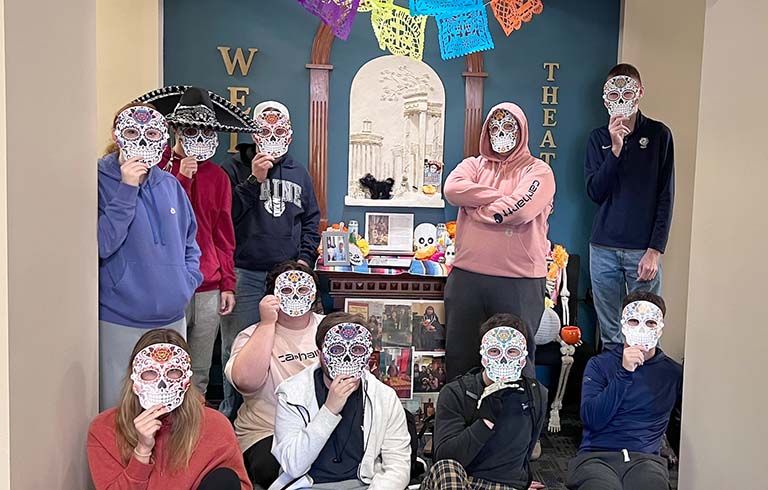
Isabel Soto, instructor, and her Spanish students have created an ofrenda (decorated altar) honoring Ana Boman, who taught Spanish in Trine University’s Department of Humanities and Communication for 16 years before she passed away last year.
Trine University has launched Dual Advantage, a new program that gives undergraduate students multiple pathways to earn both a bachelor’s degree and an advanced degree in less time than completing both degrees separately.