Academic Policies
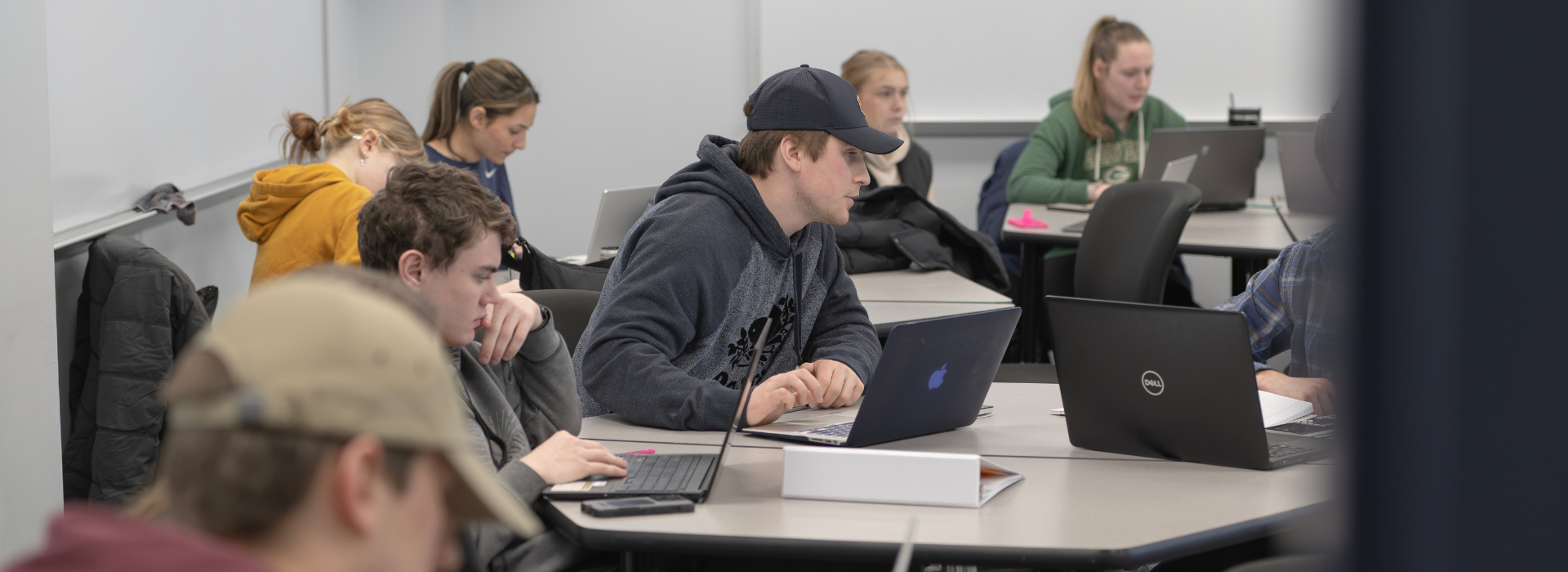
Ensuring academic integrity
Trine University has established policies for defining class attendance, excused absences, grading, academic record reporting, academic probation qualifications and academic misconduct. For questions regarding Trine's academic policies, please contact Julie Pfafman at pfafmanj@trine.edu or 260.665.4533. Additional information may be found in the course catalog.
Angola, Indiana, campus students are expected to attend all class and laboratory sessions. Absences may be permitted for reasonable causes such as:
- Illness
- Disabling injury
- Death or serious illness in the immediate family
- Court order
- Participation in university-sponsored activities
Written documentation of the reason for the absence may be required and, in the case of university-sponsored events, such documentation will be provided by the university sponsor.
It is the student's responsibility to discuss pending absences (field trips, athletic competitions, etc.) with their professors prior to the absence. The faculty member may require the student to complete any work due prior to the absence. Class or team lists distributed via email do not excuse a student from class or laboratory sessions, but rather provide confirmation to the faculty member that the activity is indeed university-sponsored.
It is the instructor's responsibility to present a class attendance policy to each class at the beginning of the semester. Decisions regarding submission of assignments will be at the instructor's discretion, but students may not be penalized for absences due to reasonable cause.
The awarding of grades is the prerogative of the classroom instructor in accordance with policies posted in the Trine University catalog. Faculty members are responsible for informing students of their grading policies as indicated on the course syllabus for that class. Grades become official when they are reported to the registrar; however, the following occurrence is possible:
- If a faculty member discovers incorrectly reported grades due to miscalculation or clerical error, the error should be reported by the faculty member to the registrar immediately.
- The appropriate department chair must approve any adjustment of grades.
| A | Excellent | 4.0 |
| B+ | Very Good | 3.5 |
| B | Good | 3.0 |
| C+ | Above Average | 2.5 |
| C | Average | 2.0 |
| D+ | Below Average | 1.5 |
| D | Poor (lowest passing grade) | 1.0 |
| F | Failure | 0.0 |
| FI | Failure (original grade of I) | 0.0 |
| S | Satisfactory | Not figured into GPA |
| TR | Transfer Credit | Not figured into GPA |
| U | Unsatisfactory | Not figured into GPA |
| I | Incomplete | Not figured into GPA |
| IP | In progress (grade deferred) | Not figured into GPA |
| W | Withdrawal before completion of 80% of the semester | |
| WP | Withdrawal after completion of 80% of the semester with passing work at the time of withdrawal |
A report of the student's grades earned in all courses taken during a semester is posted online at the end of each term. Grade reports for first year main campus students are mailed to permanent addresses for domestic students and to local addresses for international students.
A permanent record of all the student's courses, credits and grades earned is kept in the Office of the Registrar. The student should maintain a record of courses, credits and grades each term and check from time to time to see that this record agrees with the university version. The official record may also help the student determine eligibility for any activity that requires meeting specific scholastic standards.
For Undergraduate Programs, Angola Campus and College of Graduate and Professional Studies
The academic performance of every student is monitored by the registrar and the academic departments to determine satisfactory progress. Students with GPAs below 2.0 will receive a letter warning them that they have fallen below the standard required for graduation.
Students are placed on probation in the following situations:
- Degree-seeking students who have attempted 59 or fewer semester hours at Trine University and are more than six cumulative honor points below the 2.0 graduation standard.
- Degree-seeking students who have attempted 60 or more semester hours of course work and have a cumulative grade point average lower than 2.0. Transfer hours are added to Trine University hours attempted for purposes of determining the 60 hours attempted.
A student on academic probation will have one semester to reach minimum standards or be dismissed. Students on probation who achieve at least a 2.0 GPA in summer courses will not be dismissed. Students on probation who raise their cumulative GPA to acceptable academic graduation standards will be removed from probationary status.
For more information on academic probation, please see the course catalog.
The university prohibits all forms of academic misconduct. Academic misconduct refers to, but is not limited to, the following activities:
- Copying another person's work and claiming it as your own, or submitting the same paper in two different courses without knowledge and consent of the instructor (plagiarism);
- Requesting or purchasing materials from outside sources not consistent with the expectation of the assignment or assessment;
- Using the work of a group of students when the assignment requires individual work;
- Looking at or attempting to look at an examination before it is administered;
- Using materials during an examination that are not permitted;
- Allowing another student to take your examination for you;
- Intentionally impeding the academic work of others;
- Using any electronic device to transmit portions of questions or answers on an examination to other students;
- Using any electronic to improperly store information for an exam;
- Knowingly furnishing false information to the university;
- Assisting other students in false information to the university
Moreover, a student is expected to submit their own work and to identify if any portion of work that has been borrowed from others in any form. Failure to adhere to the policy above is considered academic misconduct. An ignorant act of plagiarism on final versions and minor projects, such as attributing or citing inadequately, will be considered a failure to master an essential course skill and is considered academic misconduct. A deliberate act of plagiarism, such as having someone else do your work or submitting someone else's work as your own (e.g., from the Internet, fraternity file, etc., including homework and in-class exercises), is also academic misconduct and will result in more serious penalties.
In situations of academic misconduct, instructors have the authority to award a failing grade on the assignment in question or a failing grade for the course. Upon approval by the appropriate dean, academic misconduct may also result in expulsion from the university.